
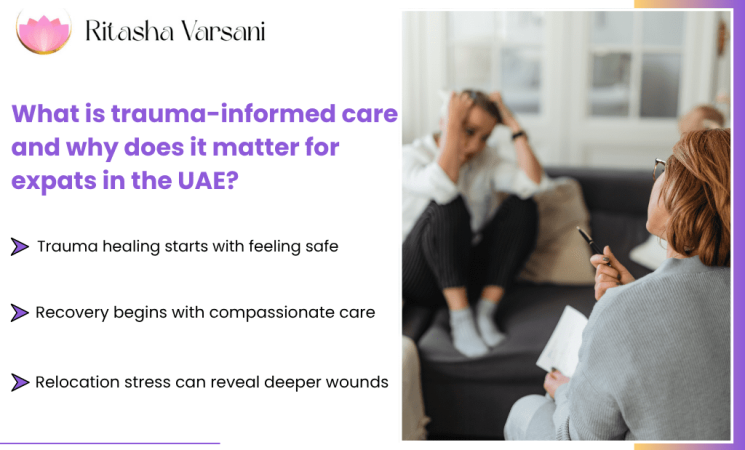
Moving to Dubai sounds glamorous on paper – tax-free salaries, year-round sunshine, and a lifestyle many dream about. But behind the excitement, many expats quietly struggle with loneliness, pressure, identity shifts, and the emotional challenges of building a life far from home. What rarely makes the brochure is the quieter cost. There’s the friend group you left behind, the family you can only see on a screen, and the version of yourself that had to adapt fast just to keep up. For many expats, that adjustment brings more than stress: it can wake up old wounds that had been sitting quietly for years.
Trauma-informed care gets mentioned a lot. But most people leave the page still unsure what it actually looks like in a therapy room.
What Trauma-Informed Care Actually Means
Trauma-informed care starts from one assumption: your body is still reacting to things your mind has long since filed away. A psychologist in Dubai working this way doesn’t ask “What’s wrong with you?” They ask “What happened to you, and how is your body still responding to it?”
In practice, this looks like:
· Safety first, always. Sessions are paced so you never feel cornered into sharing more than you’re ready for.
· Trust built slowly, not assumed. Your therapist earns it through consistency, not credentials alone.
· Choice at every step. You decide what gets discussed and when — control that trauma often takes away.
· Collaboration over instruction. You’re treated as the expert on your own life, with the therapist as a guide.
· Cultural awareness woven in. Your background, religion, and identity shape how trauma shows up and how healing should happen.
A trauma-informed psychologist in Dubai will hold all five of these at once, rather than jumping straight to “homework” or generic coping tips

Why Expat Life in the UAE Raises the Stakes
Distance changes everything about how trauma shows up. Being far from home doesn’t just remove your support network – it removes the people who know your history. Living in the UAE adds its own layer of pressure on top of whatever you’re already carrying.
· No backup. The aunt who’d notice. The friend who’d just show up. They’re a flight away now, not a phone call.
· Career and visa pressure. For many professionals, mental health struggles feel risky to admit when your residency is tied to your job.
· A small, interconnected expat community. Confidentiality matters more here, not less — you might run into your therapist’s other client at brunch.
· Cultural mismatch in care. Generic Western frameworks don’t always fit someone raised with different family expectations, religious values, or ideas about emotional expression.
· Relocation itself as a trigger. New environments, unfamiliar systems, and constant transitions can reactivate old trauma responses, even ones you thought you’d dealt with years ago.
· Burnout that looks like ambition. In a city where 70-hour weeks are a badge of honour, the warning signs get reframed as work ethic until the body stops cooperating.
This is exactly why generic counselling sometimes falls short for this population, and why therapy for trauma and anxiety needs to be built around the realities of expat life, not just textbook theory.
Signs Your Nervous System Might Be Asking for Help
Most people who need trauma support aren’t having flashbacks. They’re just tired in a way sleep doesn’t fix. Maybe it’s trouble sleeping or waking up at 3am with your mind racing. Maybe it’s feeling jumpy and on edge even on a day off or struggling to trust new people who’ve given you no real reason not to. For some, it shows up as snapping at small things, or going numb when something big actually happens, or a pattern of relationships and jobs that all seem to end the same way. And sometimes it’s purely physical – a clenched jaw you notice at the end of the day, a stomach that’s been off for months, shoulders that never fully drop. If several of these feel familiar, it’s worth a conversation with a trauma therapist in Dubai rather than waiting for things to escalate.

How a Trauma-Informed Approach Helps You Heal
So, what does this actually look like week to week?
· Pacing that respects your nervous system. Instead of pushing you to “process everything,” a trauma-informed therapist Dubai professionals can trust will slow down whenever your body signals overwhelm.
· Culture-aware therapy. If your family doesn’t talk about emotions openly, or your faith shapes how you think about struggle, those become part of the work – not an obstacle to it.
· Online trauma therapy Dubai residents can access from anywhere. Whether you’re in Dubai for six months or six years, online therapy across UAE time zones means consistency even when your schedule or location changes.
· Confidential therapy in Dubai for executives and other high-visibility professionals, with discretion built into how sessions are scheduled and conducted.
· Evidence-based tools, including CBT, narrative therapy, compassion-focused work, and nervous system regulation therapy, chosen based on what your specific history calls for – not a one-size-fits-all script.
· Family-inclusive options. Therapy for international families recognizes that trauma recovery is rarely just an individual project; it often involves partners, children, or extended relationships too.
Real progress means your body finally registers that the danger has passed. That recognition, not endless reliving of the past, is what emotional resilience therapy in Dubai actually builds toward.
Real Case Study: An Expat’s Journey Through Trauma-Informed Therapy with Ritasha
(Details below are composited and anonymized to protect client confidentiality.)
Client: “Ritasha, I don’t understand what’s happening. I moved to Dubai for a great opportunity, but I feel anxious all the time. I can’t sleep properly, and even small problems at work feel overwhelming.”
Ritasha: “When did you first notice these feelings becoming more intense?”
Client: “A few months after relocating. At first, I thought it was just adjusting to a new country, but it keeps getting worse.”
Ritasha: “Relocation can be stressful, but sometimes major life changes can also bring older emotional experiences to the surface. What goes through your mind when something doesn’t go as planned?”
Client: “I immediately think I’ve failed. I worry people will think I’m not good enough.”
Ritasha: “Have you felt that way before, perhaps earlier in life?”
Client: (pauses) “Actually, yes. Growing up, I felt a lot of pressure to be perfect. Mistakes were never really accepted.”
Ritasha: “That connection is important. It sounds like the challenges of moving abroad may be triggering old beliefs about self-worth and performance.”
Over the next few sessions, Ritasha helped the client understand how past experiences were influencing present reactions. Together, they explored emotional triggers, anxiety patterns, and the impact of living away from familiar support systems.
Client: “I always thought my problem was work stress.”
Ritasha: “Work stress is certainly part of it, but your emotional response may be connected to experiences that began long before your move to Dubai.”
Using trauma-informed techniques, Ritasha introduced grounding exercises, nervous system regulation strategies, and healthier ways to respond to self-criticism.
A few months later, the client reflected on the progress.
Client: “I still face pressure at work, but it doesn’t control me anymore. I’m sleeping better, I feel calmer, and I’m not constantly judging myself.”
Ritasha: “What do you think has changed the most?”
Client: “I understand my reactions now. Instead of blaming myself, I can recognize what’s happening and respond differently.”
Ritasha: “That’s the goal of trauma-informed care — not just reducing symptoms, but helping you feel safer, stronger, and more connected to yourself.”
Result: The client experienced reduced anxiety improved emotional resilience, better sleep, and greater confidence navigating life as an expat in the UAE.
Trauma-Informed Therapy in Jumeirah and Across Dubai
The clinic is conveniently located in Jumeirah, providing a safe, supportive, and confidential environment for individuals seeking professional trauma-informed mental health care. For those who prefer face-to-face support, in-person appointments are available in Jumeirah with a compassionate and experienced trauma-informed psychologist.
For individuals managing demanding schedules, frequent travel, or living in different parts of the UAE, online trauma therapy Dubai is also available. This enables clients across Dubai, including Dubai Marina, Downtown Dubai, Business Bay, Arabian Ranches, Palm Jumeirah, JLT, and surrounding communities, to access professional trauma support from the comfort and privacy of their home or office.
Whether you attend sessions at the Jumeirah clinic or through secure online appointments, the goal remains the same: helping individuals understand the impact of past experiences, regulate emotional responses, overcome anxiety and stress, build resilience, and support long-term recovery through evidence-based, trauma-informed care. From relocation challenges and burnout to PTSD and unresolved childhood experiences, therapy is tailored to meet each client’s unique needs in a respectful and culturally sensitive manner.

About Ritasha Varsani – Licensed Psychologist & Psychotherapist, Dubai

Ritasha Varsani is an American-trained psychologist and psychotherapist based in Jumeirah, Dubai. With advanced clinical training from the United States, she brings extensive experience supporting individuals facing work-related stress, anxiety, life transitions, relationship challenges, and emotional wellbeing concerns.
As an Indian American psychologist, Ritasha offers a culturally informed and compassionate approach that resonates with expatriates, South Asian professionals, and high-achieving individuals navigating the unique demands of life in Dubai. Her work is grounded in creating a safe, supportive, and non-judgmental space where clients can explore challenges, build resilience, and develop healthier coping strategies.
She provides both in-person appointments in Jumeirah and secure online therapy sessions across the UAE, making professional psychological support accessible and flexible. Her integrative clinical approach combines cognitive behavioural therapy (CBT), psychodynamic principles, and mindfulness-based techniques, tailored to each client’s unique circumstances, goals, and personal experiences. Ritasha works with concerns including burnout, occupational stress, anxiety, panic symptoms, relationship and family dynamics, identity-related challenges, and executive mental wellbeing, while also offering online psychological support for stress and anxiety across the UAE.
Conclusion
Trauma rarely announces itself with a label. For most expats, it shows up as unexplained anxiety, a racing mind at 3am, or a quiet sense of bracing for the next thing to go wrong. These are symptoms often blamed on “just adjusting,” long after adjustment should have settled in. The truth is, relocating to a new country doesn’t just test your logistics; it tests every coping mechanism you built long before you ever saw Dubai’s skyline. That’s exactly why trauma-informed care matters here more than most places – it meets you where you are, at the pace your nervous system can actually handle. It doesn’t push generic advice that ignores your history, culture, or the unique pressures of expat life.
Whether you’re navigating burnout in Business Bay, isolation in Arabian Ranches, or patterns that followed you from somewhere else entirely — support is available. In person in Jumeirah, or online wherever you are in the UAE. Reaching out rarely requires an obvious crisis more often, it’s simply the moment you decide you don’t have to carry it alone anymore. If any of this feels familiar, that’s worth paying attention to. A first conversation with Ritasha doesn’t have to mean committing to anything – it’s just a conversation.
FAQs- What is trauma-informed care and why does it matter for expats in the UAE?
1. What does “trauma-informed care” mean in simple terms?
This refers to your therapist acknowledging your responses as being linked to the workings of your nervous system due to your experiences rather than blaming your character for what’s happening. It is no longer asking “what is wrong with you” but rather “what happened to you?”
2. How does that differ from general counselling?
General counselling is likely to concentrate on the immediate problem. When it comes to a trauma-informed psychologist based in Dubai, he or she will assess how the past experiences might be affecting the current problems that you are facing.
3. What if I haven’t experienced any major trauma before? Does this still apply to me?
Yes. Trauma doesn’t have to mean a single dramatic event — ongoing pressure from high expectations or an unpredictable home growing up counts too, and trauma-informed therapy can still help.
4. Why does this apply more to expatriates?
Being away from family, navigating visa-linked job pressure, and adjusting to a new culture all stack on top of whatever you were already carrying. Relocation has a way of surfacing old patterns — someone who never dealt with childhood instability, for instance, might find that a routine work setback in Dubai triggers a disproportionate sense of panic. That’s exactly why trauma-informed care for expats needs to account for the move itself, not just the symptom in front of it.
5. Are trauma therapy sessions online just as good as in-person sessions?
Yes, for most clients. Trauma therapy sessions held online from Dubai work fine for clients that require continued counselling, particularly when they have hectic schedules or travel frequently, but sessions conducted personally in Jumeirah work best for people that prefer physical consultations.
6. How confidential will this be, considering how small the expatriate community is here?
Privacy is embedded within the scheduling and execution of sessions; this is even more important in a close-knit community where you may actually know the clients your therapist sees. This point is particularly pertinent in terms of confidential therapy in Dubai for executives.
7. Will starting therapy affect my job or visa status?
No, seeking therapy has no bearing on your visa or employment status. The hesitation many professionals feel is understandable, but it’s based on stigma, not any actual reporting requirement tied to residency.
8. What period is normally required for trauma therapy to begin showing effects?
This can differ from individual to individual; however, it is observed that the majority of patients start seeing changes within just a few months after regularly attending their therapy sessions, as highlighted in the case study provided above.
9. Does Ritasha specialize in working with Indian or South Asian expats?
Yes. As an Indian-American psychologist in Dubai, Ritasha brings particular cultural insight for South Asian professionals and families, though her multicultural approach is built to work across diverse backgrounds and identities.
10. Are sessions only available in Jumeirah, or can I access this from other parts of Dubai?
Both. In-person appointments are available near Jumeirah, while online sessions reach clients across Dubai Marina, Downtown Dubai, Business Bay, Palm Jumeirah, Arabian Ranches, JLT, and beyond, so location doesn’t have to be a barrier to getting support.