

Introduction
Dubai offers families an extraordinary life on paper. But behind the school runs, the career milestones, and the brunches, many families are quietly struggling with things nobody talks about openly. Whatever is creating the tension at home, the right psychologist in Dubai can help your family find its way back to each other.
For some families, the challenge is constant conflict that seems to arise from the smallest issues. For others, it is a growing emotional distance, parenting disagreements, cultural differences, relocation stress, or the feeling that communication has slowly broken down over time. Often, families are not facing one major crisis. Instead, they are carrying the weight of many small frustrations that have accumulated over months or even years.
The Real Pain Points: What Brings Families to Therapy
Families arrive at therapy for different reasons. These are the most common ones heard inside the consulting room:
Communication Breakdown
- Conversations escalate into arguments with no resolution
- Family members feel unheard, dismissed, or constantly misunderstood
- Silence has replaced open dialogue in the home
- Teens have started withdrawing or acting out emotionally
Parenting Under Pressure
- Parents disagree on discipline, boundaries, or cultural expectations
- Raising teens across two or more cultural backgrounds creates daily friction
- Single parents and working professionals feel overwhelmed and unsupported
- Teens are struggling with identity, belonging, or transition after relocation
Relationship Strain Between Partners
- Emotional distance has grown without either partner fully understanding why
- Trust has eroded following conflict, secrets, or a significant life change
- Couples are co-parenting but no longer truly connecting
- Different cultural backgrounds are creating unspoken tension and resentment
Expat-Specific Stressors
- Adjusting to a new country while managing family expectations from back home
- Loss of extended family support networks that once served as a buffer
- Teens changing schools, losing friends, and struggling with identity
- Feeling isolated even in a city as vibrant and connected as Dubai
Intergenerational and Cross-Cultural Conflict
- Balancing traditional Gujarati or South Asian family values with modern life in the UAE
- Teens navigating parental expectations around career, marriage, or lifestyle
- Blended or multicultural families managing competing belief systems under one roof
If even one of these resonates, counselling for family problems in Dubai can offer a structured, confidential, and compassionate path forward.
Why Families in Dubai Delay Seeking Help and Why That Needs to Change
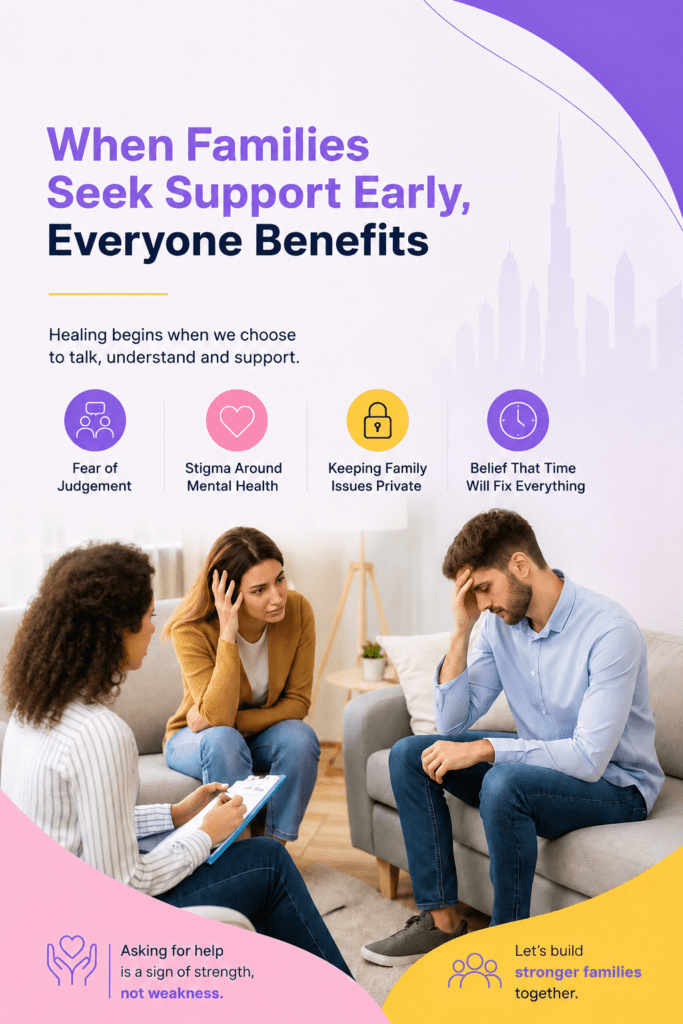
Many families – particularly within Asian, Gujarati, and expat communities in Dubai – carry a deeply held belief that family matters stay within the family. Seeking outside help can feel like admitting failure, or worse, inviting judgment from the wider community.
But the longer conflict, disconnection, and stress go unaddressed, the deeper the impact on every family member especially, teens. Emotional conflict within families that is left unresolved rarely disappears on its own. It comes back. Usually louder. And by then it has already affected the teens.
Family therapy is not about deciding who is wrong. It is about understanding why the same problems keep happening and building something different together.
There is also a common misconception that therapy is only for families in crisis. In reality, many of the most effective therapeutic outcomes come when families seek professional family counselling in Dubai early. The longer families wait, the harder the work becomes.
Seeking family counselling is not a sign that your family has failed. It reflects a commitment to protecting your relationships, supporting your children’s emotional development, and creating a healthier environment where every family member can grow. Just as families seek medical care to prevent physical illness, emotional well-being also deserves timely attention. Early intervention often leads to faster progress, stronger relationships, and more positive outcomes for everyone involved.
What Effective Family Counselling in Dubai Actually Looks Like
Every family that walks into therapy is different. Here is what the process actually looks like in practice:
Initial Assessment
A skilled family psychologist begins by understanding your family’s history, structure, relational dynamics, and the specific patterns causing distress without judgment and without taking sides. This stage is about listening deeply before offering any direction.
Goal setting Together
Therapy is most effective when every family member has a voice in identifying what they want to change. From repairing family communication problems to working through long-standing family conflict, goals are set collaboratively so that the process feels relevant and owned by everyone involved.
Practical Tools and Strategies
Sessions are not just about understanding what went wrong. You leave with something practical to try before the next one. Depending on your family’s needs, these may include:
- Structured listening exercises to reduce reactive arguments and foster genuine understanding
- Boundary-setting frameworks that are sensitive to your cultural context
- Parenting strategies that align with both partner’s values and expectations
- Tools to rebuild trust and emotional closeness after a significant relational rupture
- Communication scripts for navigating difficult conversations without escalation
Ongoing Reflection and Adjustment
Life keeps moving and so does the work. Sessions adapt as your family’s situation changes. Effective family therapy for relationship challenges adapts as your situation evolves, whether that means welcoming a new family member, navigating relocation, managing changing identity concerns, or adjusting to a partner’s career change.
Common Myths About Family Counselling in Dubai
Many families hesitate to seek family therapy services in Dubai not because they doubt its value, but because they carry certain beliefs that simply do not hold up under examination. Let us address the most common ones honestly.
“We are not broken enough to need therapy”
Family counselling is not reserved for crisis situations. Many of the families who benefit most from working with a family relationship therapist in Dubai are functioning reasonably well on the surface but feel a quiet disconnection beneath it. Most families who come to therapy are not in crisis. They just noticed the gap widening and decided to do something about it before it became unfixable.
“Talking to a stranger about private matters feels wrong”
This is an especially common feeling within Gujarati households and close-knit Asian communities where privacy is deeply valued. A professional family counsellor in Dubai is bound by strict confidentiality. Nothing leaves the room. Ever. That is not just a reassurance; it is a professional and legal obligation.
“The Teens will be unsettled by attending therapy”
Teens are remarkably perceptive. They already sense the tension, the distance, or the unspoken conflict at home. Bringing them into age-appropriate family therapy gives them language for their feelings and genuine reassurance that the adults in their lives are actively working to make things better, not hiding problems behind closed doors.
“Therapy means someone will take sides”
A skilled family conflict therapist does not take sides. Their job is to make sure everyone in the room feels genuinely heard including the person who walked in convinced they were the only reasonable one.
“It will not work for our culture”
Ritasha Varsani understands multicultural and cross-cultural family dynamics from the inside out. Your cultural values, family structure, and community expectations are never something to work around here. They are something to work with.
Family Counselling for Specific Situations
Every family arrives at therapy carrying its own story. Below are some of the most common situations that bring families to seek relationship counselling in Dubai and family conflict resolution support.
Expat Families Navigating Relocation
Moving to Dubai or moving on from it is rarely simple emotionally. Most expat families never grieve the move. They just push through. Therapy creates the first space where that exhaustion is allowed to exist without turning into blame between partners or being silently absorbed by teens who never chose the disruption in the first place. Counselling for relocating families helps each member process the transition at their own pace, while keeping the family unit intact and supported.
Multicultural Couples and Families
When two cultural backgrounds collide inside one household, neither person is wrong. But without a space to understand each other’s map, the friction quickly becomes personal. Cross-cultural family counselling in Dubai helps partners find that space.
Parenting Disagreements
Two parents can love their teen deeply and still disagree profoundly on how to raise them. Family counselling for parents in Dubai creates a space where these differences can be explored without one parent feeling overruled or dismissed. Teens do not need perfect parents. They need parents who are on the same page even when they disagree on the details.
Strained Parent-Teen Relationships
Cultural identity questions, academic pressure, and the social complexity of growing up in a city like Dubai can create real distance between parents and teens. Family communication therapy helps restore the connection, giving parents and teenagers a structured way to hear each other again.
Blended and Extended Family Dynamics
Stepparents, stepsiblings, grandparents living across borders, and extended family interference in nuclear family decisions are challenges many Dubai families navigate silently. These dynamics rarely resolve themselves at the dinner table. A neutral space makes it possible to say what has been unsayable at home.
Working Professionals Managing Family Stress
Many of Dubai’s residents are high-achieving professionals whose careers demand enormous emotional and cognitive energy. By the time they arrive home, there is often very little left. Family counselling for working professionals in Dubai acknowledges this reality and builds realistic, sustainable strategies for maintaining family connection alongside demanding careers.
Family Counselling Case Study: When Small Arguments Started Affecting the Whole Family
Client: “Ritasha, I don’t think we have a major family problem, but we’re constantly arguing. Even simple conversations end badly.”
Ritasha: “What usually starts these arguments?”
Client: “Mostly parenting. My husband thinks I’m too soft with the teens, and I think he’s too strict. Then we end up fighting in front of them.”
Ritasha: “How are the teens responding to this?”
Client: “My daughter stays quiet, and my son spends most of his time in his room.”
Ritasha: “It sounds like the conflict is affecting the entire family, not just the two of you.”
After a few family counselling sessions, the family began learning healthier ways to communicate and understand each other’s concerns.
A month later, the client returned with a smile.
Client: “The arguments haven’t completely disappeared, but they’re no longer turning into big fights. We actually listen to each other now.”
Ritasha: “That’s a significant change. What about the teens?”
Client: “They’re talking to us more, joining family dinners again, and the house feels peaceful. We feel like a family again.”
Outcome: Better communication, reduced family conflict, stronger parent-teen relationships, and a more connected family environment.
Family Counselling in Jumeirah and Across Dubai
Ritasha Varsani’s practice is situated in Umm Suqeim 1, Jumeirah one of Dubai’s most established, family-oriented, and centrally accessible residential communities. The location is deliberately chosen to offer a calm, private, and welcoming environment away from the noise and pace of the city’s commercial districts.
For busy professionals, expatriate families, and those living in different parts of the city, online family counselling Dubai is also available. This allows families across Dubai, including Dubai Marina, Downtown Dubai, Business Bay, Palm Jumeirah, JLT, Dubai Hills, Arabian Ranches, Al Barsha, JVC, and surrounding communities, to access professional support from the comfort and privacy of their home.
Whether you come in person or online, the work is the same. The only difference is where you sit. From family disagreements and relationship difficulties to relocation stress and multicultural family dynamics, counselling is tailored to meet the unique needs of each family with compassion, professionalism, and cultural sensitivity.
Every family experiences unique challenges, and counselling is never approached with a one-size-fits-all mindset. Ritasha works collaboratively with each family to understand their relationships, communication patterns, cultural background, emotional concerns, and personal goals before developing an individualised therapeutic plan.
Whether your family is experiencing ongoing conflict, communication breakdowns, parenting challenges, blended family adjustments, sibling rivalry, adolescent behavioural concerns, marital stress affecting the household, relocation-related anxiety, grief, trauma, or the complexities of multicultural family dynamics, each session is designed to strengthen understanding, improve communication, rebuild trust, and create healthier, more resilient relationships that support long-term emotional wellbeing.
About Ritasha Varsani – Psychologist in Dubai
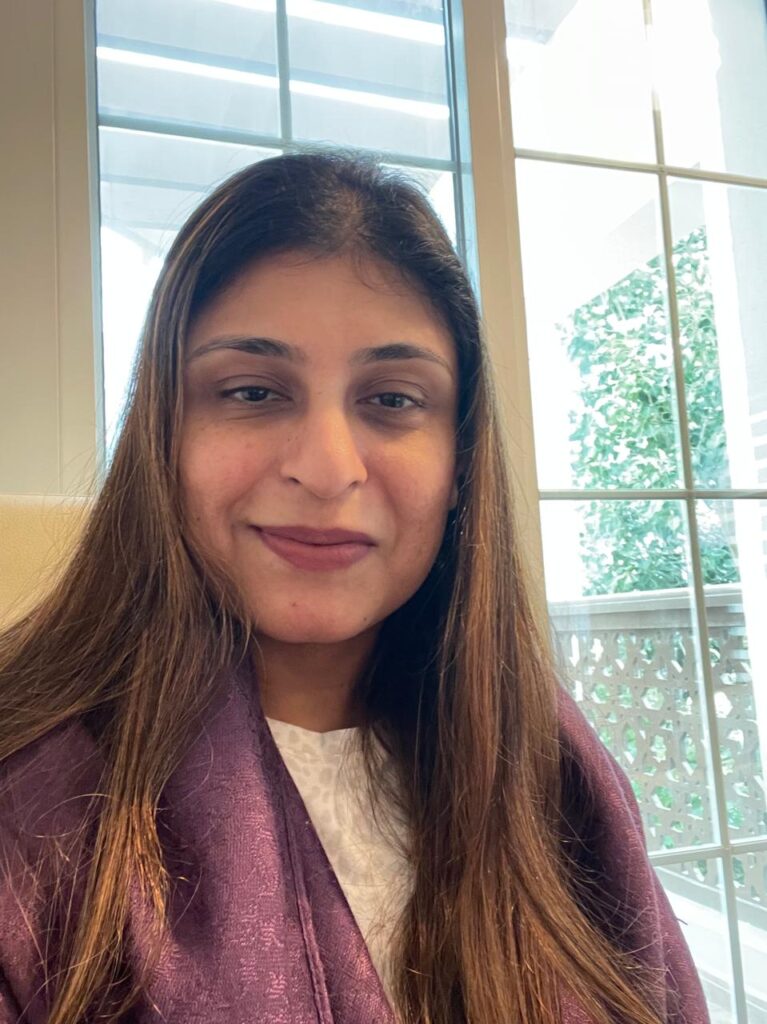
Ritasha Varsani is an Indian American trained psychologist based in Jumeirah, Dubai. What makes her approach different is not just her training; it is her understanding of what families in Dubai are actually living through.
Educated and trained in the United States, Ritasha has built extensive clinical experience across multicultural settings. She has sat with enough expat families, Gujarati households, and international couples to understand the pressures that rarely surface in a first conversation. Her approach is rooted in evidence-based frameworks and shaped entirely around your family’s identity, history, and values, not a generic programme.
Ritasha is known among her clients for the quality of her listening, the clarity of her insights, and the warmth of the environment; she creates a space where even deeply private, long-held family tensions can be explored with honesty, safety, and real compassion.
She specialises in:
- Family conflict resolution and communication repair
- Parenting challenges across single, dual-income, and multicultural households
- Relationship counselling for couples and life partners
- Family therapy through significant life transitions relocation, career change, bereavement, new additions
Conclusion
No family gets through life without conflict. The question is whether the conflict brings you closer or pushes you further apart. Whether you are facing parenting difficulties, communication breakdowns, relationship strain, cultural differences, or the pressures of expat life, professional family counselling can help create healthier patterns of understanding, trust, and connection.
With the right support, families can move beyond recurring arguments and emotional distance to build stronger, more meaningful relationships. If something at home feels broken, or just quietly off, that is reason enough to reach out. Ritasha Varsani works with families in Dubai who are ready to stop managing the tension and start actually changing it.
FAQs- Family Counselling in Dubai for Parenting, Conflict and Relationship Challenges
1. What are the signs that family counselling could be beneficial?
The clearest sign is repetitioning: the same argument, the same silence, the same distance happening again and again without anything actually changing. If tension at home has become the background noise of daily life, that is reason enough to reach out.
2. Do all family members need to attend every session?
Not necessarily. Depending on the situation, some sessions may involve the entire family, while others may focus on specific family members or relationships to address particular concerns more effectively.
3. Will family counselling be helpful for issues of communication?
Yes, and it goes deeper than just talking more. Sessions help family members understand why certain conversations always derail, and give them tools to have those conversations differently. Most families notice a shift in how they communicate at home within the first few sessions.
4. Is family counselling only for families experiencing serious problems?
No. Many families seek counselling to strengthen relationships, improve understanding, navigate life transitions, or prevent minor concerns from becoming larger challenges.
5. What role does family therapy play for multicultural and expatriate families?
Multicultural and expat families carry a specific kind of pressure that most standard therapy does not address. Ritasha’s work with these families focuses on the gap between different cultural expectations, the grief of relocation, and the identity questions that come with raising teens across two or more cultural worlds all of which can affect how families communicate and connect.
6. What if one family member is reluctant to participate?
It’s common for one partner to feel that therapy isn’t necessary or to feel hesitant about starting. That’s completely okay. Beginning with the person who is ready can still create positive change. Over time, improvements in communication, understanding, and the overall family dynamic often encourage the other partner or family members to become more open to the process.
7. Can counselling help rebuild trust within a family?
Yes. Family therapy focuses on improving understanding, accountability, and communication, which are important steps in rebuilding trust and strengthening relationships.
8. What is the frequency of family counselling sessions?
Most families begin with weekly sessions. As things stabilise and progress becomes visible, the frequency is reviewed together. There is no fixed programme; the pace is led by what your family actually needs.
9. How effective is online family counselling compared to in-person therapy?
For most families, online sessions are just as effective as in-person ones particularly for expat families managing travel, demanding work schedules, or living outside central Dubai. The therapeutic relationship and the quality of the work remain exactly the same. The only thing that changes is the commute.
10. What makes Ritasha Varsani’s approach to family counselling unique?
Ritasha combines evidence-based therapeutic techniques with a culturally sensitive approach. Her experience working with expat families, multicultural households, professionals, and diverse communities in Dubai allows her to provide personalised support tailored to each family’s unique needs.